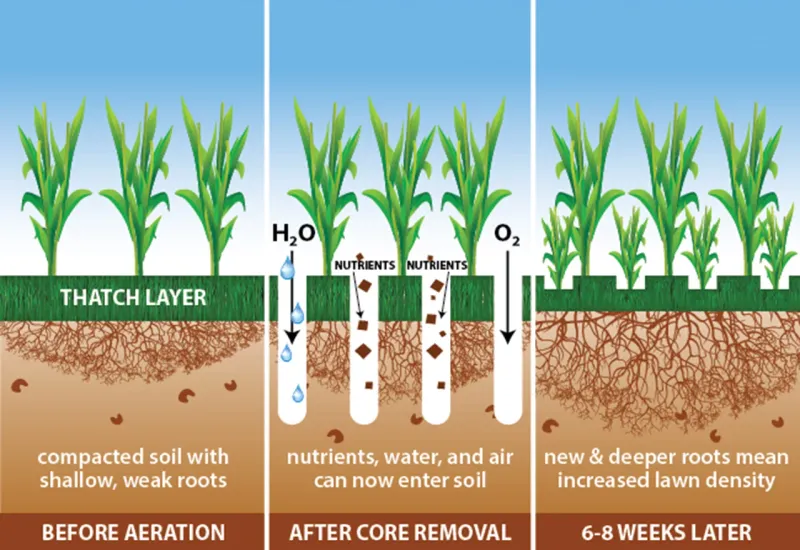
Your grass looks fine from the street. Up close, it's thin, patchy, and completely indifferent to every bag of fertilizer you've thrown at it. Here's the diagnosis: compacted soil. When soil particles press together tightly enough, roots can't push through, water runs off instead of soaking in, and fertilizer just sits on the surface going nowhere. You're essentially trying to feed a lawn that can't eat.
Lawn aeration — specifically core aeration — is the fix. A core aerator pulls small plugs of soil out of the ground, punching open channels so water, air, and nutrients reach the root zone directly. Think of it as giving your lawn room to breathe. This guide covers when to aerate (most people get this wrong), which method actually works, the step-by-step process, and what to do right after to lock in the results.
- Best time in Ontario: late August–October. Most homeowners do it in spring. That's backwards for cool-season grass — keep reading.
- Core aeration beats spike aeration — it removes soil rather than just punching holes (which actually compresses soil sideways).
- Aerate when the soil is moist — water the day before, or go the day after rain.
- Overseed and fertilize immediately after — germination rates after aeration run 30–50% higher.
- Most lawns need aeration once a year; heavy GTA clay soils may need it twice.
Why Your Lawn Needs Aeration
Compaction happens gradually, which is why most people don't notice until the lawn already looks rough. Every time you mow, walk across the grass, or let the kids use it as a soccer field, soil particles press tighter together. Over time, the top few inches become so dense that roots physically can't push through. Compacted soil is basically your lawn's version of a packed subway car — nothing moves, nothing breathes, nobody's happy.
Signs your soil is compacted:
- Water pools or runs off instead of soaking in
- The lawn feels hard underfoot, even after rain
- Grass stays thin no matter how much you fertilize
- You can barely push a screwdriver 2 inches into the ground (seriously, try it — it's the fastest diagnosis in lawn care)
- Thatch layer is thicker than ½ inch
Aerating punches through that dense layer. The open holes give water, oxygen, and fertilizer a direct line to the root zone — and your lawn finally starts responding to the care you put in. No mystery. Just physics.
Core Aeration vs. Spike Aeration: Which One Actually Works?
There are two types of lawn aeration, and they are not the same thing.
Core (Plug) Aeration
Core aeration uses hollow tines to pull out small cylindrical plugs of soil — typically ½–¾ inch in diameter and 2–3 inches deep. Those plugs get deposited on the surface, where they break down over 1–2 weeks and return organic matter back to the lawn. By physically removing soil, you create real space for roots and dramatically improve drainage and gas exchange.
This is the method used by professionals. It's the one that actually relieves compaction — not just pokes at it.
Spike Aeration
Spike aerators — including those spiked sandals you've definitely seen advertised on late-night TV — poke holes without removing any material. Here's the problem: as a spike pushes into the soil, it compresses soil sideways, which can actually worsen compaction around each hole. You're getting the appearance of aeration without the result.
Spike aeration is better than nothing on very sandy, lightly compacted soil. For most Ontario lawns — especially GTA clay — it's not worth your time. Use a core aerator. (We'll say it once and move on.)
Much of the GTA sits on heavy clay soil that compacts easily and holds water. If your yard pools after rain or gets rutted when wet, core aeration isn't optional — it's essential. A&E Lawn Care provides professional core aeration in Richmond Hill, Vaughan, and Markham.
When to Aerate: Timing for Ontario Lawns
This is where most homeowners get it completely backwards. If you've been aerating in spring because that's when lawn care season starts and it feels productive — keep reading. Spring is the wrong time for Ontario lawns.
Best Time: Late August to October
Cool-season grasses — Kentucky bluegrass, fescue, ryegrass — are what the vast majority of Ontario lawns are made of. For these grasses, late August through October is the ideal aeration window. The soil is still warm, the grass is heading into its strongest root-growth period of the year, fall rains are coming, and weed pressure is low. Aeration holes heal fast. Anything you overseed or fertilize right after gets a direct line to the root zone.
One of our clients in Markham had their previous lawn service aerate every late May. Their bluegrass looked fine in spring but declined every August — thin, stressed, slow to recover. Once we moved them to a September schedule, the difference by the following June was noticeable on the whole street. Same lawn, same products. Just the right timing.
Spring Aeration: The Secondary Option
Spring (May–June) is a legitimate second choice, not the first. Wait until the lawn has been mowed 2–3 times so the ground has settled after frost. The main downside: warm-season weeds like crabgrass are aggressive in spring and will exploit open aeration holes fast. Fall doesn't have that problem — one more reason to default to September.
What to Avoid
- Mid-summer (July–August): heat stress is already high. Aeration stresses the grass further and the lawn can't recover well.
- Right after seeding: wait at least one full growing season before aerating a newly seeded lawn.
- Right after herbicide: wait 4–6 weeks post-application so the herbicide can do its job before you disrupt the soil.
How Often Should You Aerate?
Most Ontario lawns benefit from aeration once per year. Heavy clay soils, high-traffic lawns (kids, dogs, backyard everything), or lawns with persistent thin patches may benefit from twice a year — once in late spring, once in fall.
Not sure if you need it? Do the screwdriver test: push a standard flat-head screwdriver straight down into your lawn. If it takes real effort to get 2 inches deep, your soil is compacted. Sandy soils compress less and can often go every two years. Clay soils? Assume annually until you've proven otherwise.
How to Aerate Your Lawn: Step-by-Step
Step 1 — Prepare the Lawn
- Mow to your normal height 1–2 days before aerating.
- Water the lawn the day before so the soil is moist but not muddy. Dry, hard soil causes tines to bounce off or only penetrate an inch — which defeats the whole exercise.
- Flag every sprinkler head, shallow cable, and utility line. This isn't optional. Core tines go 3 inches down and irrigation lines often live right in that zone.
Step 2 — Choose Your Aerator
Core aerators rent for $80–$120 for a half day at most home improvement stores. They're heavy, awkward to transport, and rental units are often worn enough that tines only pull ½–1.5 inch plugs — significantly less than the 2.5–3 inches you need to actually relieve compaction. For lawns over 5,000 sq ft, you're looking at a solid afternoon of work. It's doable, just go in knowing that.
Alternatively: hire a professional service that uses commercial-grade equipment, already has your irrigation heads mapped, and can combine aeration with overseeding in a single visit. For most homeowners who aerate annually, it's comparable in cost to renting once you add up time, transport, and gas.
Step 3 — Make Two Passes at 90°
Run the aerator north-to-south for the first pass, then east-to-west for the second. This crisscross pattern ensures adequate coverage — target 20–40 holes per square foot. Overlap slightly at the edges of each pass to avoid leaving skipped strips.
Step 4 — Leave the Plugs
The soil plugs scattered across your lawn after aeration look like something went wrong. They didn't — leave them. They'll break down within 1–2 weeks after rain or regular watering, returning organic matter back to the soil as they do. Raking them up defeats part of the purpose.
Step 5 — Topdress (Optional, High ROI)
Spreading a thin ¼-inch layer of compost over the lawn right after aerating is one of the highest-return moves in residential lawn care. It works into the aeration holes, improves soil biology, and builds long-term structure over multiple seasons. If you're doing one extra thing, do this.
After Aeration: Overseed, Fertilize, Water
Aeration creates the best seedbed your lawn will have all year. Open holes give grass seed direct soil contact — germination rates run 30–50% higher after aerating than on unprepared ground. Don't let that window sit unused.
Overseed Right Away
Spread grass seed within 24–48 hours of aeration. For Ontario lawns, a mix of Kentucky bluegrass (spreads by rhizome, fills bare patches) and hard fescue (shade-tolerant) covers most situations. Apply at the overseeding rate on the bag — roughly half the rate used for a bare-ground install.
Fertilize After Aerating
Fall is the single most important fertilization window for cool-season turf. Apply a slow-release, phosphorus-containing starter fertilizer (look for a meaningful middle number — something like 12-24-12) right after aerating. The nutrients travel directly into the root zone through the holes. The efficiency you get here is something you don't get any other time of year.
Worth saying again: fall fertilizer outperforms spring fertilizer for cool-season grasses every time. Timing matters more than the product.
Water Consistently
If you've overseeded, keep the seedbed moist until germination — typically 7–14 days. Light watering twice a day if there's no rain. Once the new grass reaches 1 inch, shift to deep, infrequent watering: about 1 inch per week.
Pre-emergent weed killers work by forming a chemical barrier at the soil surface. Aeration disrupts that barrier. If you've applied a pre-emergent this season, wait until fall — and don't apply one after aerating if you plan to overseed.
DIY vs. Professional Lawn Aeration
We'll be straight with you: DIY aeration works. Plenty of homeowners do it well every year. Here's the honest breakdown so you can make the call:
- Equipment rental: $80–$120 for a walk-behind core aerator. Heavy, bulky to transport, and rental units often have worn tines that pull shallow plugs — which is exactly the thing you're renting the machine to avoid.
- Time: A 4,000 sq ft lawn takes 1.5–2 hours to aerate properly at two passes. Add transport, refueling, and return, and you're looking at most of a Saturday morning.
- Tine depth matters: You want 2.5–3 inches per plug. Many rental units top out at 1.5 inches on a good day. Commercial aerators pull deeper, consistently.
- Professional service: A&E Lawn Care serves Richmond Hill, Vaughan, and Markham with commercial-grade equipment. We mark your irrigation heads before we start and can bundle aeration with overseeding and fertilization in one visit.
For homeowners who aerate annually, the math often favors hiring out — especially factoring in equipment quality. But if you like doing it yourself, renting and DIYing is a solid option. Either way: get it done in September.
Frequently Asked Questions
- University of Minnesota Extension: Lawns & Landscapes — research-backed aeration technique guides for cool-season lawns
- Lawn Aerator — Wikipedia — types of aeration equipment and how they work
Ready for Professional Lawn Aeration in Richmond Hill?
A&E Lawn Care provides core aeration and overseeding across Richmond Hill, Vaughan, and Markham. Book before September and take advantage of prime fall aeration timing.